
AI Value Chain
From Generative Models to Business Value

These days, AI is evolving at an incredible pace — new frameworks and models are coming out every day, and what’s considered state-of-the-art today might already be outdated tomorrow.
All this noise creates three main challenges for me: first, keeping up with all the innovations, second, being able to clearly explain to our clients where exactly DareData adds value in the AI value chain, third, decide where DareData product investment should go.
Implementing technology at a company only creates value if it solves real, concrete use cases with measurable impact. Technology helps businesses make money in three ways: by helping them sell more, by reducing costs, or by increasing the productivity of their people — which, in the long run, also translates to more revenue or lower costs.
The AI Value Chain can be splitted in two main layers:
1. Foundation Layer
This is the technical core where all the heavy lifting happens. It includes the infrastructure, data, and models that power generative AI systems. Key components:
A. Large Language Models (LLMs) & Foundation Models
Models like GPT-4, Claude, LLaMA, or open-source alternatives. These are general-purpose models trained on massive datasets and can be adapted to specific needs.
B. Data Infrastructure:
Data lakes, pipelines, vector databases (e.g., Pinecone, Weaviate) for storing and retrieving unstructured and structured data.
C. Compute & Deployment
Cloud-based GPUs/TPUs, containerized environments, and orchestration tools that allow GenAI applications to scale.
2. Application Layer
This is where GenAI creates tangible business impact. It includes the tools, interfaces, and use cases that deliver value to end users.
A. Agent Frameworks
Frameworks that enable the creation of autonomous AI agents that can reason, plan, and act across multiple steps — like LangChain, AutoGPT, or CrewAI.
Useful for tasks such as report generation, process automation, or multi-system integrations.
B. Vertical GenAI Applications
Domain-specific solutions tailored to concrete problems — like summarizing legal documents, automating customer support, or generating marketing content.
C. Agent Operation / Human-in-the-Loop Interfaces
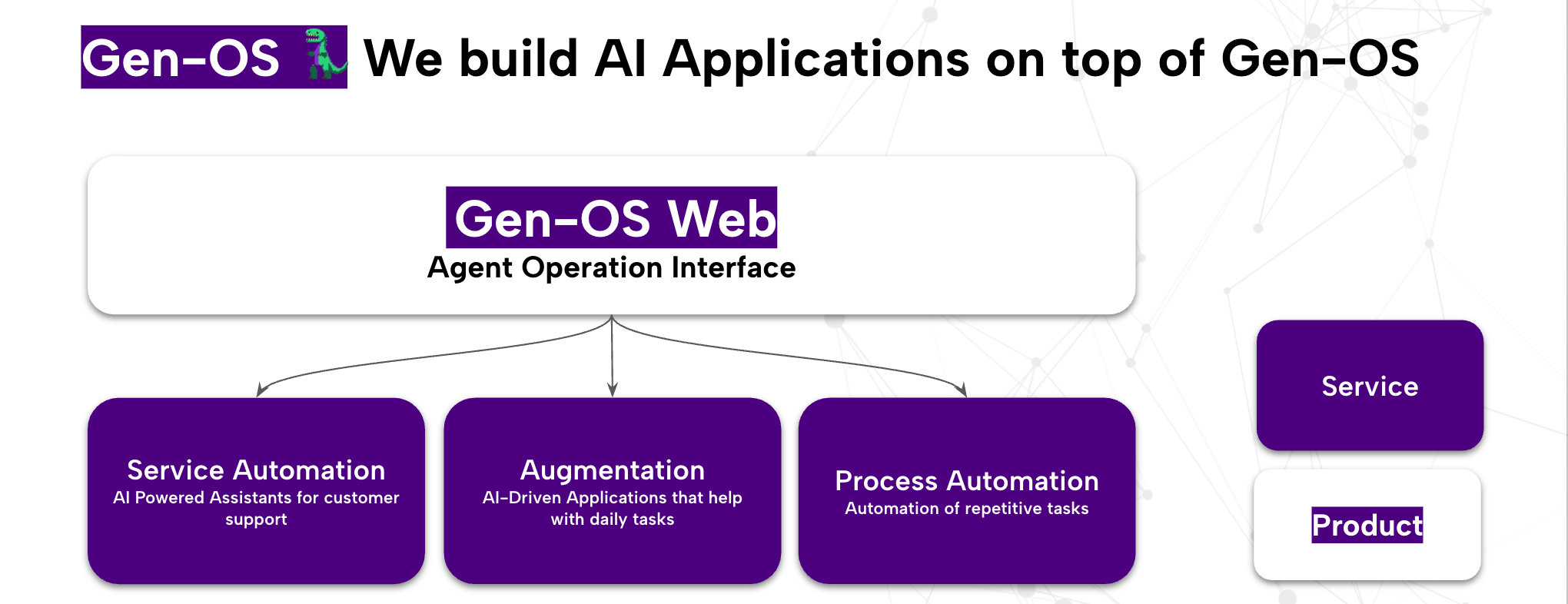
These are interfaces where humans interact with AI systems — guiding, supervising, and learning from them. They are critical to putting GenAI in production responsibly and effectively allowing the transition of the current processes to the GenAI-era. These interfaces are becoming the new operating system for work — shifting how humans interact with machines
At DareData, we help our clients implement real-world use cases that extract measurable value from AI. Our focus is clearly on the Application Layer — with our consulting services we solve business problems by building agents using Python-based Agent Frameworks. To bring these agents into production, we layer our product, Gen-OS, on top. This provides the operational layer needed to run agents reliably, with human-in-the-loop supervision in order to ensure quality, safety, and continuous improvement.
Brilliantly concise and insightful breakdown of the AI value chain—great read!